Scientific guide · Published October 23, 2026 · Updated October 23, 2026
Sildenafil improvement reports: making room for a fuller answer
A short outcome label can start a useful discussion. Examine whose answers were counted, what the label leaves open and which questions belong with a clinician.
AI-assisted public-document editorial research · No clinician sign-off or firsthand treatment testing. Source access dates appear with each reference.
A percentage may appear to finish a conversation before it has begun. Someone reading about treatment could reasonably want to know whether improvement means a small difference, a dependable change or the resolution of the difficulty that brought them to care. Those are separate questions, even when a headline puts them beneath one reassuring word.
This reading uses a research figure as a starting point for original methodological discussion. The aim is to make an account of change more precise: identify the available answers, distinguish observation from assumption, and bring the unresolved personal questions into an actual clinical conversation. The fictional examples below illustrate reasoning; they are not additional research findings or accounts of real patients.
In this article
Study overview
- Study context
Twelve-week randomized, blinded oral-tablet comparison.
- Selected outcome
Improvement reported by question respondents.
- First reading question
Which records belong beneath the numerator?
- Personal context
Eligibility requires its own clinical assessment.
- Working distinction
Keep the observation, interpretation and proposed next step separate.
Trial figure and data
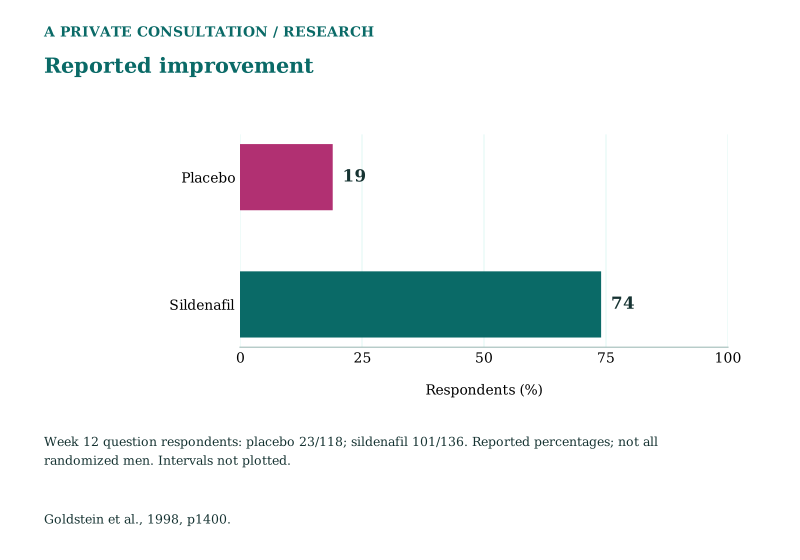
Download chart (PNG)Download data (CSV)Download vector (SVG)
| Group | Percent |
|---|---|
| Placebo | 19 |
| Sildenafil | 74 |
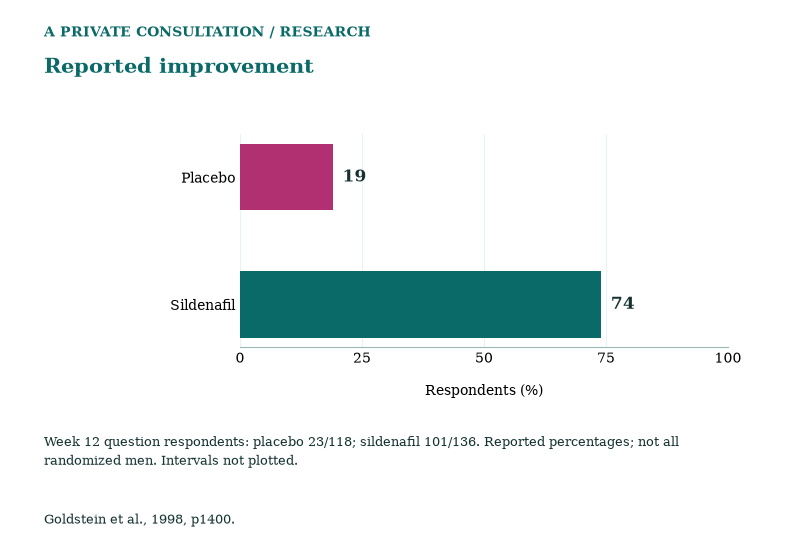
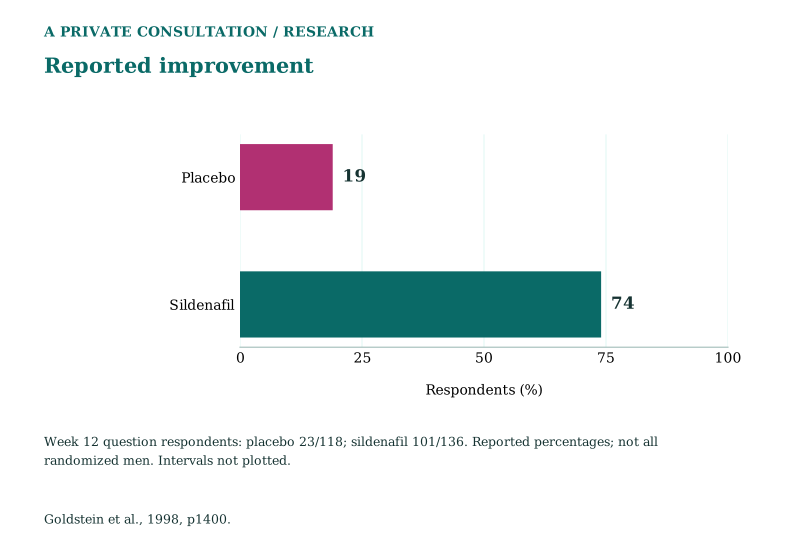
Week 12 question respondents: placebo 23/118; sildenafil 101/136.
Reported percentages; not all randomized men. Intervals not plotted.
Begin with a description that another person can understand
For this editorial exercise, imagine replacing the word improvement with a blank space. What would have to go into that space before another person understood the change? A description might identify a particular difficulty, say whether it became less troublesome, and explain what still interfered with a valued activity. These are dimensions of a description, not a new questionnaire or a test that readers should score themselves.
An outcome label compresses information. Compression can be useful when many records need to be summarized, but information left out of the label does not become unimportant. A brief answer may convey an overall judgment while leaving its size, regularity and personal importance unexplained. The appropriate next question therefore depends on what the listener is trying to learn, rather than on how decisive the label sounds.
Before a consultation, a reader can distinguish the words they feel comfortable using from the conclusions they hope a clinician will assess. Our guide to describing a first appointment history offers related reading. The purpose of greater specificity is to support that discussion, not to arrive with a self-assigned diagnosis or an argument that a published average must apply.
Give a blank response its own place in the record
Consider an entirely fictional register containing seventeen invitations to report an outcome. Eleven replies arrive: seven positive and four negative. Six spaces remain blank. A summary of the received answers uses eleven as its denominator. A summary of all invitations uses seventeen. Neither denominator can be substituted for the other while leaving the meaning of the resulting fraction unchanged.
The blank spaces contain no observed answer. Marking them negative would create a particular assumption; marking them positive would create another. Excluding them answers a question about the available replies. That may be a useful description, but its usefulness does not establish that the people who answered and those who did not had the same experience. The reason for the missing information requires evidence of its own.
The table organizes this imaginary register without trying to repair it. Notice that the categories describe records, rather than characterizing people as successful, unsuccessful or unreliable. In a conversation about a percentage, asking how unanswered records were handled is more precise than assuming that every enrolled person must be represented in the displayed result.
| Record category | Imaginary count | What the record supports |
|---|---|---|
| Positive reply | 7 | An observed positive assessment |
| Negative reply | 4 | An observed negative assessment |
| No reply recorded | 6 | No observed answer in this register |
Keep random assignment distinct from later observation
Random assignment concerns how people enter comparison groups. The later availability of their outcome records is a different stage. To see the distinction, imagine two groups created by a fair draw, followed by a reporting process in which some responses never arrive. The fairness of the draw does not, by itself, explain why those particular responses are missing.
This does not mean that missing information automatically reverses a result. It means that a reader must identify the question supported by the records actually analyzed. A conclusion about received replies and a conclusion about everyone initially assigned are different claims. Moving from one to the other needs a stated method and defensible assumptions, rather than confidence borrowed from the word randomized.
A useful reading habit is to trace the sequence: assignment, observation, inclusion in the calculation and interpretation. At each transition, ask whether the same people remain represented. If the account leaves a transition unexplained, retain that uncertainty instead of supplying a plausible story. An imagined explanation can make a narrative feel complete while making the evidence less accurately described.
Put the reporting period inside the sentence
A statement about change needs a reference period. In an original thought experiment, suppose one account refers to a difficult evening and another to a longer stretch containing easier and harder occasions. Both might use a positive summary word. They would still organize experience differently. The time frame is part of what the account means, not a detail that can be removed after the percentage has been calculated.
Another distinction concerns the time of reporting versus the time being described. A report collected on a particular date might summarize earlier experience. A later conversation might instead focus on what is happening now. The dates alone do not tell a reader whether the two accounts answer the same question. Clear communication needs the period of interest as well as the date on which someone answered.
For a clinical discussion, it can help to separate the original concern, the period being recalled and any subsequent change. That is an organizational suggestion, not a prescribed tracking schedule. The clinician can decide what history or further assessment is appropriate. A research observation window should not quietly become an instruction about how long someone ought to wait before raising a concern.
Leave space between a positive answer and a complete outcome
Imagine a general assessment scale that permits only a positive or negative response. The positive category could contain descriptions of different magnitudes. It could also contain descriptions that emphasize different priorities. This is a logical property of a broad category: sharing the label does not establish that the accounts within it are interchangeable.
The distinction matters when a reader tries to translate a report into a personal goal. A goal needs its own description. It might concern a particular difficulty, its consistency or its effect on a relationship, but an editorial article cannot determine which description is clinically appropriate for an individual. A discussion can clarify the concern without treating one favorable word as a promise that every related problem has disappeared.
Our companion reading on daily tadalafil score categories examines another way an outcome can be compressed. Read the two approaches as separate measurement questions. The table below supplies original prompts for unpacking a broad answer; it does not reconstruct unreported participant experiences or reproduce a research questionnaire.
| Dimension to clarify | Information still needed | Possible discussion prompt |
|---|---|---|
| Magnitude | How substantial the described difference is | What specifically became easier or less difficult? |
| Consistency | Whether the description fits every relevant occasion | When does the description fit, and when does it not? |
| Importance | Whether the change addresses the original concern | Which part of the concern remains unresolved? |
Describe a group contrast without assigning personal odds
For an unrelated arithmetic illustration, imagine two fictional surveys reporting positive assessments from thirty-nine percent and sixty-one percent of their respective respondents. Subtracting the percentages gives a difference of twenty-two percentage points. That calculation describes the contrast between those summaries. It does not reveal which particular person would change their answer under a different condition.
The same distinction separates a group comparison from an individual forecast. A forecast would require information connecting a particular person, a defined outcome and a relevant setting. Simply selecting the more favorable group percentage does not provide that connection. Nor does a percentage-point difference state how much improvement any individual experienced; the unit remains a difference between proportions.
Uncertainty also survives a clean-looking chart. A bar ends at one displayed estimate, but that endpoint should not be interpreted as a boundary between certainty and impossibility. Questions about precision, missing information and the appropriateness of the comparison remain relevant. A reader can ask which question the estimate answers before asking how strongly it answers it.
Treat eligibility and unwanted effects as separate questions
The current Viagra label contraindicates nitrates and guanylate cyclase stimulators such as riociguat. It also requires attention to cardiovascular suitability and interacting medicines. Headache, flushing and dyspepsia are reported adverse reactions. These label facts concern clinical assessment and safety, rather than the interpretation of a favorable outcome percentage.
A useful conversation therefore has more than one track. One track asks what benefit was observed or hoped for. Another asks whether the proposed medicine is appropriate in the person’s circumstances and what information must be reviewed. Success on the first track does not settle the second. A reassuring research summary cannot substitute for a complete account of current medicines, relevant health history and concerns.
Read the guide to cardiovascular assessment alongside the discussion of nitrates and riociguat. Those readings identify subjects for qualified care, not a home method for choosing combinations or working out a safe interval. If an explanation sounds like a timing puzzle that an online article could solve, return the question to the clinician or pharmacist instead of improvising a rule.
Identify the preparation before transferring a conclusion
Compounded preparations have no FDA approval. The agency does not assess their safety, quality and effectiveness before they are marketed. Its explanation recognizes medical needs that compounding can address. That is neither a guarantee for a finished mixture nor evidence that every compounded preparation fails.
An original way to organize this problem is to treat product identity as a set of fields that need to be matched. An ingredient name is one field; the preparation being discussed and the evidence supporting it are others. A match in one field does not fill the remaining fields automatically. If the description changes along the path from paper to offer to prescription, that change needs to be made explicit.
For practice examining public descriptions, see our Hims consultation review. Reading a provider’s documents can help formulate questions about responsibilities and the proposed product. It does not produce a new efficacy study. The practical question is which evidence supports the actual preparation under discussion, and who is qualified to explain the limits of that evidence.
Prepare a follow-up account that preserves uncertainty
A follow-up conversation can become less informative when someone feels required to deliver a single verdict. An original alternative is to separate what was noticed from what remains uncertain. The description might identify a change, acknowledge an unresolved concern and explain whether the account is based on a clear recollection or a rough impression. These distinctions help another person understand the information being offered.
This is not a request to generate a personal research dataset. Nor does it imply that readers should alter treatment to test an explanation. It is a way to avoid converting uncertainty into an apparently precise claim merely because a short answer seems easier to give. The clinical team can decide what additional questions, examination or follow-up are warranted.
Our guide to information for a prescription follow-up continues that discussion. Before the appointment ends, a reader can clarify who should receive a new concern and how that contact works. A useful next step identifies a responsible professional and an unresolved question; it does not require the reader to infer a treatment adjustment from a published percentage.
Distinguish questions for the paper from questions for care
Pfizer supported the work; consulting and company affiliations, plus company design, logistics and analysis roles, were disclosed. Funding and contributor roles belong beside the evidence because they help readers understand how the report was produced. They neither supply missing observations nor, by themselves, invalidate every reported observation.
Different uncertainties have different destinations. A question about an analysis may require the underlying research methods. A question about someone’s health belongs with their clinical team. A question about the organization responsible for a service may require the relevant public documents. Treating these as interchangeable can leave a reader with an answer that is accurate yet unrelated to the problem they were trying to resolve.
The Ro consultation review provides another opportunity to read a provider’s documents with that distinction in mind. A publication can help identify the kind of information to seek; it cannot complete a clinical assessment or establish that a particular conversation has occurred. The strongest use of a research figure is often a more exact next question, with its remaining uncertainty still visible.
Questions about the evidence
Should an unanswered outcome question be counted as a negative answer?
Not automatically. An absent response and an observed negative response contain different information. Any rule that converts one into the other is an analysis choice that needs to be stated and justified. Leaving the response out also changes the population described by the resulting fraction.
Does a positive overall assessment mean every concern has resolved?
That conclusion does not follow from a broad category alone. Different descriptions can fit the same category. A useful discussion asks what changed, how the person understands that change and what remains important, rather than treating a compact label as a complete account.
Which symptoms require attention beyond an ordinary follow-up?
The Viagra label calls for immediate medical help for an erection lasting over four hours. Sudden vision loss or sudden hearing decrease or loss requires stopping the medicine and prompt medical attention. Chest pain, dizziness or nausea during sex requires stopping sexual activity and immediate help.
Why keep the percentages in the form printed in the report?
Recalculating a rounded presentation can imply a level of precision that the displayed report did not use. Preserve its stated form, then examine the definition and denominator. Additional decimal places cannot repair an unclear population or explain what happened to information that was not observed.
What is a useful question to bring from this reading?
Ask which part of the evidence helps address the concern being discussed and which part needs an individual assessment. That separates a research description from a clinical decision. It also leaves room to clarify the exact preparation and the professional responsible for explaining it.
Editorial assessment
The most useful contribution of an improvement percentage is a disciplined starting point. Identify the records included in the calculation, retain the reporting period, and resist replacing a broad response with a detailed outcome that was never established. Then separate the research interpretation from the questions that require personal clinical assessment. A reader does not need to arrive with a predicted response or a proposed regimen. A clearer description of the concern, a careful account of uncertainty and a question directed to the right professional can make the conversation more informative without turning editorial reading into medical care.
Research access and limitations
Complete retained papers were read; current downloads were restricted. Separate protocols, supplements and individual data were not reviewed. The examples and discussion prompts are original editorial illustrations, not additional observations. This publication provides no clinician sign-off, firsthand treatment testing or individualized assessment.
Original sources
Access notes distinguish the research examined from current prescribing and regulatory information.
- Goldstein et al. (1998): oral sildenafil trialRetained primary paper; recheck restricted · Checked October 23, 2026Exhibit PDF (recheck restricted)Source-register context →
- VIAGRA (sildenafil citrate) US prescribing informationCurrent prescribing information · Checked October 23, 2026Source-register context →
- Porst et al. (2006): daily tadalafil trialRetained primary paper; recheck restricted · Checked October 23, 2026Exhibit PDF (recheck restricted)Source-register context →
- Understanding the risks of compounded drugsFDA public information · Checked October 23, 2026Source-register context →