Scientific guide · Published October 23, 2026 · Updated October 23, 2026
Daily tadalafil categories: discussing the person beyond the score
A threshold organizes an outcome, but it does not describe every change within it. Explore the starting population, score boundaries and questions that remain for a clinical conversation.
AI-assisted public-document editorial research · No clinician sign-off or firsthand treatment testing. Source access dates appear with each reference.
A category can be easy to remember and difficult to interpret. Crossing a line sounds decisive, yet the meaning depends on where the line sits, who was eligible to cross it and what information the classification leaves behind. A person’s concern may also extend beyond the particular dimension that a research measure summarizes.
The chart introduces a score-based result; the discussion develops original ways to reason about it. Fictional records and numerical examples are used only to explain measurement. They are not patient stories, new study data or a form for assessing yourself. The purpose is to prepare better questions about evidence while leaving diagnosis, prescribing and individual interpretation with qualified clinicians.
In this article
Study overview
- Study design
Randomized, blinded tablet comparison; secondary endpoint.
- Questionnaire measure
IIEF-EF: erectile-function domain.
- Eligibility question
Establish who could enter the numerator before interpreting its size.
- Missing-score method
Last observation carried forward.
- Reading principle
A category and a personal goal need separate descriptions.
Trial figure and data
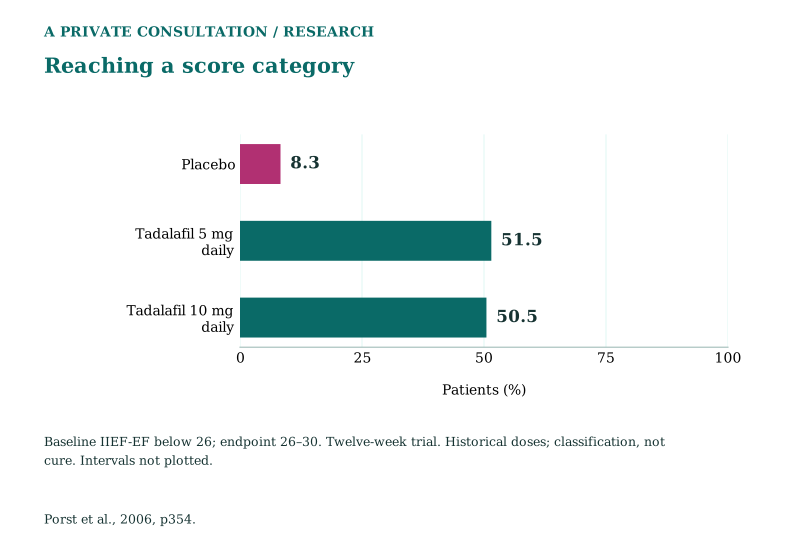
Download chart (PNG)Download data (CSV)Download vector (SVG)
| Group | Percent |
|---|---|
| Placebo | 8.3 |
| Tadalafil 5 mg daily | 51.5 |
| Tadalafil 10 mg daily | 50.5 |
Baseline IIEF-EF below 26; endpoint 26–30. Twelve-week trial.
Historical doses; classification, not cure. Intervals not plotted.
Name the job performed by a threshold
A threshold is a rule for sorting measurements. It converts a range of possible values into categories on either side of a boundary. That operation makes a large collection easier to summarize, but it also removes distinctions among values placed in the same category. The rule may be useful without being a complete description of each record it sorts.
An original analogy is a height marker on a storage shelf. Knowing that a package fits beneath the marker does not reveal its exact height, weight or contents. The classification answers the question defined by the marker. It does not acquire information about every other feature simply because the resulting label is convenient. A questionnaire category likewise needs to be interpreted according to the dimension being measured.
For a clinical discussion, the first task is to identify the question attached to the measurement. Is the interest in a location on a scale, a change over time, or a concern that the instrument does not directly describe? These questions can coexist. Keeping them distinct allows a reader to discuss the result without assuming that a category has settled every aspect of health or experience.
Compare the journey with the destination
Consider a completely invented instrument running from zero to forty, with a category beginning at thirty. It has no clinical validity and is used here only for arithmetic. Record A moves from seventeen to twenty-nine; record B moves from twenty-nine to thirty. A travels farther along this imaginary scale, while only B crosses the chosen boundary.
The two records demonstrate why amount of change and category membership are different descriptions. Neither description is a substitute for the other. Counting crossings can answer a well-defined question, but it does not identify the largest changes. Summarizing changes can describe movement, but it does not reveal how many records finished on a particular side of a boundary.
The illustration is deliberately detached from a real questionnaire. Its purpose is to show the structure of the reasoning, not to suggest an alternative diagnostic rule. When discussing a category result, ask what additional information would be needed to describe the trajectory. Without that information, a reader should not supply an imagined starting point or assume that everyone who crossed experienced the same amount of change.
| Fictional record | Imaginary score path | Relation to the boundary at thirty |
|---|---|---|
| A | 17 to 29 | Larger movement; remains below the boundary |
| B | 29 to 30 | Smaller movement; crosses the boundary |
Inspect the entry rule before interpreting the fraction
A crossing question first needs an eligible starting population. In a fictional set of one hundred records, suppose twenty-five already belong to the destination category before observation begins. A question about newly entering that category would concern a different starting set from a question about the entire collection. The selection rule is part of the outcome’s definition.
Excluding records that already meet a threshold does not label those records failures. It identifies the population capable of contributing the kind of event being counted. Conversely, adding them back without changing the question can make the denominator answer something else. A displayed percentage is therefore incomplete as an explanation until the reader knows both the qualifying event and the eligibility rule.
This is a reason to resist borrowing a convenient denominator from another table. A study may contain several analyses that draw on overlapping but nonidentical sets of records. Their totals can be correct for their own purposes while being unsuitable for a different endpoint. Trace the inclusion rule for the selected outcome rather than assuming one published group size must serve every calculation.
Look for differences hidden inside one category
After a boundary has been applied, the category itself can conceal variation. Some fictional records might finish just inside it, while others finish farther away. Some might have moved substantially; others might have changed little. Membership alone does not reveal this internal arrangement. A compact summary is useful partly because it omits detail, and its limits follow from that same feature.
A conversation can recover some relevant detail by returning to the concern that prompted care. Our reading on the history for a first appointment focuses on making that concern understandable. The point is not to translate every personal experience into a score. It is to prevent an available score from replacing a description of what the person actually wants help understanding.
There are also different ways to ask about an outcome. Compare the measurement discussion in our sildenafil improvement-report article. A broad assessment and a score category do not become interchangeable merely because each can be expressed as a percentage. They can contribute different information, and a clinician may need context that neither summary supplies.
Resist reconstructing people from rounded percentages
A rounded percentage does not uniquely identify the counts that produced it. As an unrelated mathematical example, one divided by fourteen and two divided by twenty-eight both round to about seven-point-one percent. The displayed percentage alone cannot distinguish those numerators and denominators. Many possible records can collapse into the same printed number.
Trying to reverse this process creates a risk of false specificity. If someone selects a group size from elsewhere and multiplies it by the percentage, the resulting decimal may look like an approximation to a real count. That calculation is justified only if the denominator actually belongs to the selected outcome and the rounding process is understood. A nearby table is not sufficient proof.
The practical reading question is whether the report supplies the count needed for the claim being made. If it does not, retain that gap. Do not convert a rounded result into a statement about a particular number of people simply because whole-person counts feel easier to communicate. Honest uncertainty about a denominator is more informative than a precise-looking reconstruction built on an unstated assumption.
Ask what an endpoint record represents in time
Efficacy required baseline and postbaseline measurement. Beyond that brief eligibility fact, consider the general distinction between a fresh observation and an assigned value. In an original timeline example, a measurement exists in early May, while a later planned measurement is absent. Reusing the earlier value creates an analysis record; it does not create a new observation on the later date.
The arithmetic can be explicit while the biological course remains unknown. A rule that reuses an earlier value does not establish that the underlying condition stayed constant. Nor does the absent later measurement prove that it improved or worsened. The reader must separate what was recorded, how the analysis filled a gap and what can reasonably be concluded about the period that was not observed.
This distinction changes how an endpoint should be described in conversation. A label attached to the end of an analysis need not imply that every included person supplied a fresh measurement on one identical day. Ask which observations support the endpoint and which assumptions connect them. That question examines the construction of the evidence without inventing a reason for any particular missing record.
Give a small separation between bars the right meaning
Two bars can be close without establishing that the underlying interventions are equivalent. They can also be different heights without settling whether one is superior. A visual separation is an observation about displayed estimates. A stronger conclusion requires an appropriate comparison, its uncertainty and a clear account of what difference would matter for the question being investigated.
For an original logical example, suppose two groups are each compared with the same reference group. Evidence concerning those two separate comparisons does not automatically provide an answer to a direct comparison between the groups themselves. The relationship that has been tested matters. It cannot be replaced by arranging the bars from tallest to shortest and treating that order as a clinical recommendation.
The same caution applies to the word equal. Failing to establish a difference is not the same proposition as establishing acceptable similarity. A reader should ask what claim the analysis was designed to assess and what information supports that claim. In a consultation, the useful question concerns the relevance of the evidence; the chart is not a device for selecting or adjusting a personal dose.
Separate the measurement question from the product question
FDA’s explanation of compounding distinguishes a legitimate medical need from an approval claim. Compounded drugs are not FDA approved, and the agency does not evaluate their safety, effectiveness or quality before marketing. The presence of a familiar ingredient does not establish evidence for every finished preparation containing it.
A measurement result and a product description therefore need different checks. One asks how an outcome was defined and analyzed. The other asks exactly what preparation is being discussed and which evidence supports it. A clear answer to one question does not fill an empty space in the other. The original comparison below keeps these tasks separate without assigning a clinical verdict to any provider.
Readers can use our Hims consultation review to practice examining documentary responsibilities. A review can organize public information and identify questions to ask. It cannot make the treatment studied in one setting identical to another preparation, or verify an individual’s suitability. Those are questions for the relevant clinical and pharmacy professionals, with the actual proposed product identified.
| Question being asked | Information needed | What a category percentage does not supply |
|---|---|---|
| How was the outcome classified? | The measurement rule and eligible records | A complete account of each person’s experience |
| What preparation is proposed? | Its exact identity and supporting evidence | Automatic equivalence across formulations |
| Is it appropriate for this person? | An individual clinical assessment | A prescribing decision |
Keep current prescribing context beside historical research
Current Cialis labeling describes 2.5 mg and 5 mg daily ED regimens. Higher trial dosing is outside that labeling. Historical research labels are not personal instructions. Nitrates and guanylate cyclase stimulators, including riociguat, are contraindicated. Cardiovascular suitability, interacting medicines and kidney or liver function need clinical assessment. Reported adverse reactions include headache, dyspepsia, back pain and muscle pain.
These facts answer a different kind of question from category membership. A favorable efficacy summary does not determine whether a particular prescription is suitable, and an unfavorable personal experience does not identify the correct adjustment. A clinical discussion needs the relevant health and medicine history, the concern being addressed and an explanation of the responsibilities around ongoing care.
The guides on nitrates and riociguat and cardiovascular assessment provide supporting reading. They should not be treated as instructions for solving a contraindication through timing, substitution or an improvised combination. Keeping the research question and the prescribing question distinct helps prevent a numerical result from becoming a recommendation it was never designed to provide.
Record which question still needs an answer
Disclosures identify Lilly ICOS funding, company authors and Lilly analysis/writing support. Such information helps place a report in context. It does not determine, on its own, whether a particular analysis is sound, and it cannot supply details absent from the available record. Assess the methods and the disclosed relationships without asking either to do the other’s job.
A practical editorial suggestion is to leave a discussion with the unresolved question expressed clearly. It might concern the interpretation of a measurement, the exact preparation or responsibility for subsequent contact. Our guide to the review after a first prescription considers how information can support that next conversation. It does not turn a research category into a self-directed treatment plan.
The Ro consultation review offers another public-document reading exercise. Distinguish what a service document establishes from what would require a clinical conversation or evidence of an actual action. A useful outcome of reading is a question directed to the right professional, with its assumptions visible and its missing information acknowledged.
Questions about the evidence
Can someone change substantially without crossing a category boundary?
Yes as a matter of measurement logic. Movement along a scale and finishing beyond a selected boundary describe different properties. The invented example in this article demonstrates that distinction; it is not a clinical scoring guide or a claim about individual participants in the research.
Can I infer the number of people from the displayed percentage?
Only if the correct denominator and relevant rounding information are available. A percentage by itself can arise from multiple underlying counts. Using the size of a different analysis group can create a plausible-looking answer to a question that was never actually calculated.
Does a closely spaced pair of bars prove the regimens are equivalent?
No. Equivalence is a specific claim that needs an appropriate analysis and a defined standard for acceptable differences. Visual closeness alone provides neither. It also does not authorize choosing a regimen or changing a prescription based on the order of the displayed estimates.
Which urgent symptoms should not wait for a routine review?
Cialis labeling directs immediate medical help for an erection beyond four hours. Stop the medicine and obtain prompt care for sudden vision loss or a sudden reduction or loss of hearing. During sexual activity, chest pain, dizziness or nausea means stopping the activity and seeking immediate help.
How can I discuss a score without letting it replace my concern?
Explain the concern in ordinary language, then ask which part the measurement addresses and which part still needs assessment. You do not need to complete an online diagnostic exercise or predict your category. A professional can interpret the relevant information in the context of your circumstances.
Editorial assessment
A score category is most useful when its boundary, eligible population and observation rules remain visible. It offers one organized description, not a complete biography of the people counted. The scientific reading task is to understand that description before extending it to another question. The clinical task requires a person’s own context and a qualified assessment. Keeping those tasks connected without collapsing them together leaves room for both careful interpretation and a more informative consultation.
Research access and limitations
Retained papers were reviewed; downloads remained restricted. Protocols, supplements and individual data were not examined. Fictional instruments and records illustrate reasoning only. No diagnostic tool, clinician sign-off, firsthand treatment testing or personal prescribing recommendation is provided.
Original sources
Access notes distinguish the research examined from current prescribing and regulatory information.
- Porst et al. (2006): daily tadalafil trialRetained primary paper; recheck restricted · Checked October 23, 2026Exhibit PDF (recheck restricted)Source-register context →
- Goldstein et al. (1998): oral sildenafil trialRetained primary paper; recheck restricted · Checked October 23, 2026Exhibit PDF (recheck restricted)Source-register context →
- Cialis (tadalafil) prescribing informationCurrent prescribing information · Checked October 23, 2026Source-register context →
- Understanding the risks of compounded drugsFDA public information · Checked October 23, 2026Source-register context →